
Wood Works: Katie Walkowski’s Scenic Carpentry
Welcome to “Wood Works,” a new monthly series profiling SBWI Alumni who are working at the intersections of carpentry, fine art, mass timber, and more. Follow along on our website or sign up for our newsletter to never miss a story.
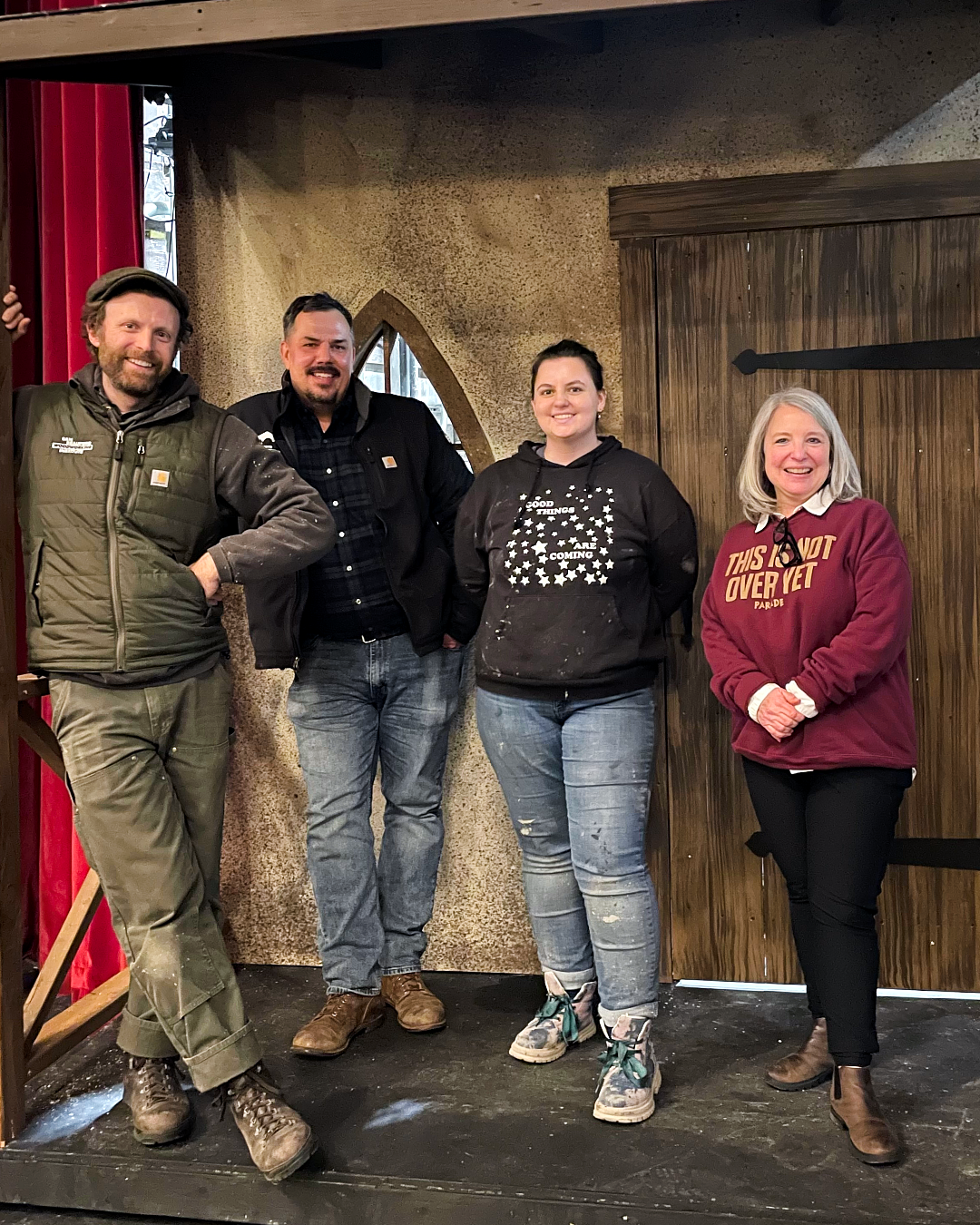
(Left to Right): Peter Densmore, Luke Barnett, Katie Walkowski and Jere Righter
Adrian’s creative community thrives when local institutions work together.
The partnership between the Sam Beauford Woodworking Institute (SBWI) and the Croswell Opera House is a clear example of how education, skilled trades, and the performing arts can form a connected ecosystem that brings high-quality productions to the stage while creating meaningful career pathways for local artists. At the center of that story is Katie Walkowski, a recent SBWI graduate who now works behind the scenes at the Croswell as a scenic carpenter.
For the Croswell, Michigan’s oldest theater (approaching its 160th anniversary in 2026), community support has always been essential. Due to community investment and strong leadership, the theater now draws audiences and performers from well beyond Lenawee County, producing a full slate of shows from May through December, with a new production opening nearly every month during the Broadway season. That pace requires a dedicated, skilled, creative team of people who can design, build, problem-solve, and adapt quickly.
Behind each show’s visual world is a team of scenic artists, carpenters, and prop masters who turn design drawings (sometimes fully technical, sometimes sketched on the back of a napkin) into functioning sets and environments. And now, SBWI grad Katie is part of that team. Her work ranges from carving faux floors out of plywood to shaping trees from cardboard and chicken wire, to building Cinderella's carriage for the ball. Every project is different, and every show has its own demands.
Katie originally discovered woodworking while studying art and sculpture at the University of Michigan. She found herself drawn to wood as a material but didn’t have access to the full range of tools or machinery in college. “I got a taste of woodworking, but not the whole meal so to speak,” she says. When she graduated and began looking for her next step, she realized she wanted more hands-on experience and a deeper understanding of the craft. Her exploration eventually led her to the Sam Beauford Woodworking Institute.
“For a while it was just a dream, like, what if I went to woodworking school?” she says. She began researching the program, imagining what it might look like to go back to school and get the experience she’d been craving. “I kept thinking about it more seriously — what would this actually look like?” When she finally visited the campus, everything clicked. “I really fell in love with the building, and the people,” she says. “It just seemed like where I was meant to be. So I took the leap and did it.”
After graduating, she explored a few different job opportunities, including a position carving carousel horses in Ohio, but ultimately connected with the Croswell Opera House. The mix of construction, artistry, problem solving, and teamwork suited her perfectly.
Working Together to Create More Opportunity
For Luke Barnett, president of SBWI, Katie’s journey is precisely the kind of outcome the school strives to create. “Most people look at us and think ‘skilled trade school,’ and we are,” he says. “But we’re also an art school. We stand at the intersection of fine arts and skilled trades. The opportunity to bring our students into places like the Croswell shows them the creative pathways they can take with their skills—and then they actually go and do it.”


That intersection is where the larger ecosystem becomes visible. Adrian has always been home to artists, makers, performers, and creatives, but sustaining a career in the arts can be challenging in any community. Both the Croswell and SBWI see their roles not only as providers of education or entertainment, but as contributors to a broader effort around sustaining a career as a skilled creative.
“We want to be a place that makes living and working as an artist in this community possible,” says Jere Righter, Executive Director of the Croswell. She emphasized that while the theatre cannot employ a massive full-time staff, it can create consistent paid opportunities for actors, musicians, designers, carpenters, and technicians, often in combination with other artistic or part-time work. That mosaic of opportunities helps keep creative talent local.
Jere notes that partnerships with organizations like SBWI strengthen that effort. When a skilled graduate steps into a role like Katie’s, it’s not only a benefit to the theatre; it reinforces a network of support that encourages other artists to stay, grow, and contribute to the local arts landscape. “It’s incredible what has happened at SBWI,” she says. “It has transformed a whole segment of our community and will continue to do that.”
Luke echoes the sentiment, emphasizing the importance of collaboration rather than competition among arts organizations. “Some people think from a famine mindset—that there’s not enough to go around,” he says. “But it’s a feast. If we’re all in it together, we create more to feast on. We’re creating an actual community.”
This season, that collaboration is visible in Cinderella, which runs through December 7th. The production features everything audiences expect, beautiful gowns, classic songs, and magical transformations, but also a fresh, empowered interpretation of the story. Behind the scenes, Katie and her colleagues have built the sets, props, and environments that bring the show to life. As the Croswell approaches a historic milestone and SBWI continues to grow, both institutions share a vision for Adrian’s future: a place where artists can learn, work, and stay.
Their partnership shows what becomes possible when an arts community invests in itself—not just in buildings or equipment, but in people like Katie who bring skill, creativity, and dedication to every project.