
Woodworking institute carves new path with historic preservation training
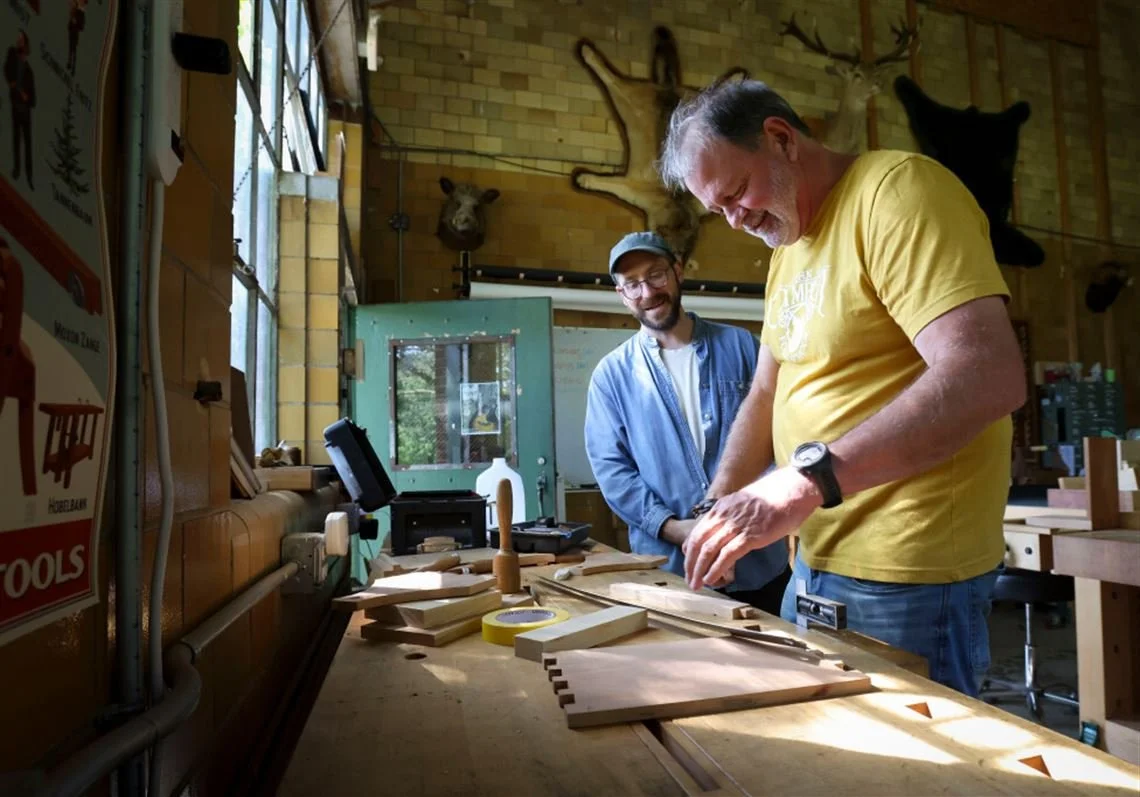
Instructor Zack Fealk guides a student in a Hand Cut Joinery class at SBWI
ADRIAN — In Adrian College’s Hickman Gallery, a dark mahogany spiral curls from a black pedestal, suspending a small cabinet and a single rose in a delicate feat of balance.
Nearby, geometric drawers and dressers covered in art deco marquetry blur the line between furniture and art.
These pieces were designed and built by Sam Beauford Woodworking Institute students, many of whom arrived with little experience and left months later creating work that looked anything but beginner.
Now the school is using its hands-on model to help train workers in another skilled trade: historic preservation.
The institute recently became an approved training provider for the Campaign for Historic Trades’ nationally recognized registered apprenticeship program, which is overseen by the U.S. Department of Labor and state work force agencies. Under the partnership, eligible classes at Sam Beauford can count toward the classroom instruction apprentices need to advance in designated preservation trades.
For Luke Barnett, the school’s founder and president, the new approval answers a growing need.
“Preservation is a very large trade,” Mr. Barnett said. “You have all these old buildings that, rather than tear down and rebuild modern, you have to preserve them. It takes very specific skills.”
Mr. Barnett, an internationally renowned Windsor chair maker, started the school in 2015. Since then, the institute has expanded to include continuing education classes and a selective accredited trade program that draws students and employers from around the world.
“We get people who are experienced woodworkers who just want to deepen their knowledge of a particular technique or students that have never been in a woodshop before,” Peter Densmore said.
Mr. Densmore, the institute’s chief of staff, completed the institute’s wood-design program in 2025 and now teaches there. He said the preservation training fits naturally with the school’s mission and goals.
While historic preservation has long been a larger trade on the East Coast, where buildings tend to be older, Mr. Barnett said the need is growing in the Midwest as its own buildings age.
“These specialized skills are only being more and more in demand,” he said.
The work can range from repairing an old house to meeting strict landmark standards, sometimes requiring craftspeople to match original materials and methods.
The school’s qualifying classes include timber framing and historic window restoration. In a historic window class, students make a window while learning both traditional hand-tool methods and more modern machine-based approaches.
Mr. Barnett said the goal is not to use old tools just because they are historic, but to teach students how to choose the most effective method for the job.
“The carpenters who built Mount Vernon would certainly have used automation if it was available at that time,” he said.
The approval comes as the institute prepares to expand into a 24,000-square-foot campus with wings devoted to preservation, furniture making, and timber framing, a relocation Mr. Barnett said is needed because demand has outgrown the school’s current space.
Marissa Bennett, 1 of 24 students in the wood-design class of 2026, relocated from Traverse City, Mich., with virtually no woodworking experience.
“My background is in hospitality, so learning how to make these beautiful pieces has just been incredible,” she said.
Along with new skills, she found a tight-knit, uplifting community.
Although furniture making can be a solitary activity, Mr. Densmore and Mr. Barnett both agreed students learn faster when they share mistakes and discoveries. The expansion into historic trades is another way students connect craftsmanship with opportunity and community.
“It’s an opportunity for employers to get skilled people,” Mr. Barnett said. “And an opportunity for the students to make a living doing something that they love.”
Source: First Published July 2, 2026, 2:57 p.m. - Toledo Blade