
What Is Mass Timber and Why Does It Matter for Woodworkers?
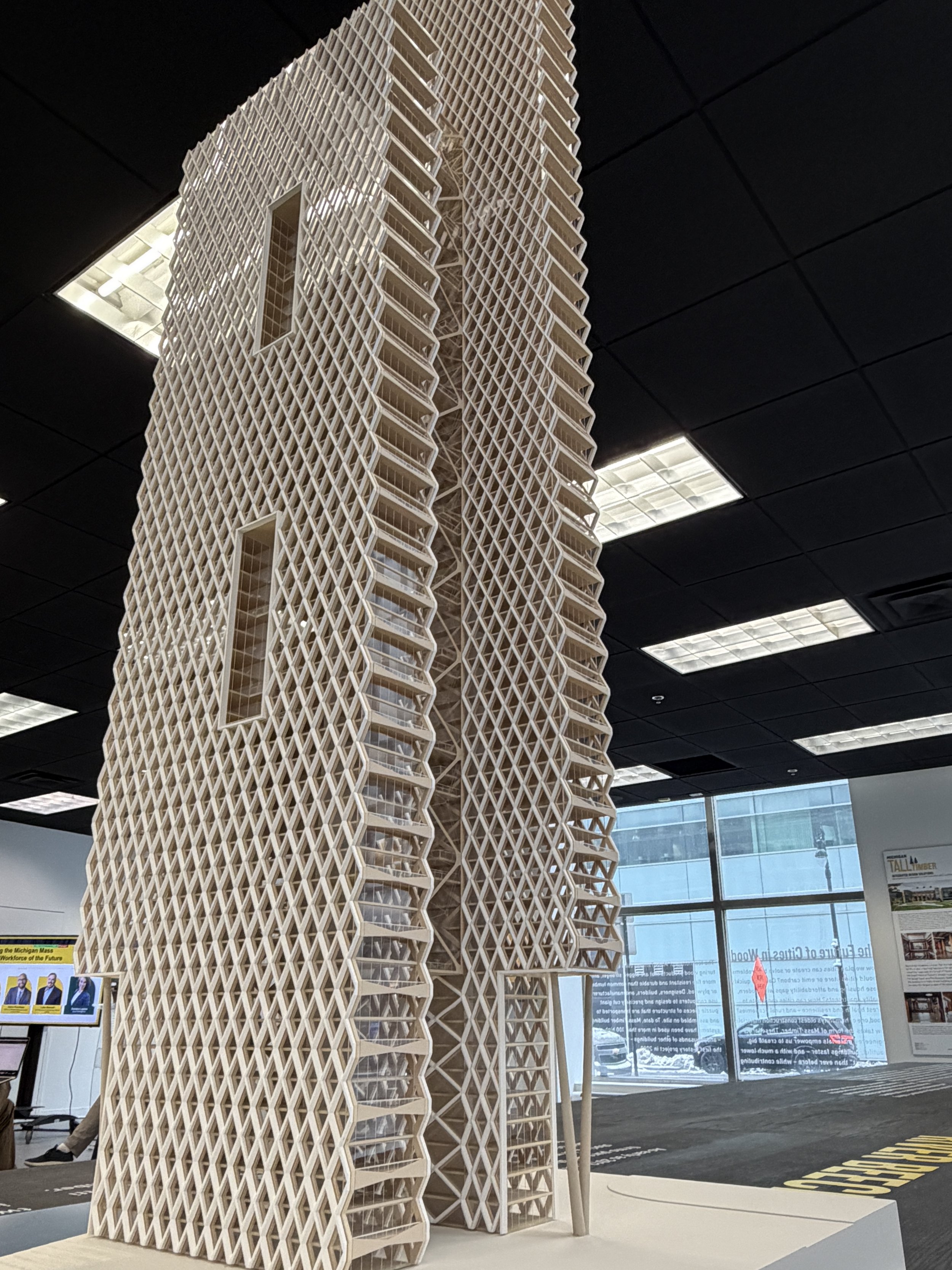
A scale model of mass timber construction at the “Tall Timber: Cities in Wood” Exhibition.
If you’re curious about where woodworking and the future of building intersect, mass timber is one of the most exciting developments in the construction world.
What Is Mass Timber, and Why Does It Matter for Woodworkers?
Mass timber is a category of large-scale, engineered wood products used to build modern structures, including multi-story residential, commercial, and institutional buildings. Instead of small, dimensional lumber assembled piece by piece, mass timber uses layers of wood bonded together to create strong structural panels and beams.
Products like cross-laminated timber (CLT) and glued-laminated timber (glulam) allow wood to compete with steel and concrete in strength, while offering major sustainability advantages. Because wood stores carbon and is renewable when responsibly harvested, mass timber is helping reshape how we think about the future of construction.
For woodworkers, mass timber represents a shift from craft at the scale of furniture or cabinetry to craft at the scale of buildings. It combines traditional knowledge of wood behavior with digital design, CNC fabrication, and precision installation. As more architects and builders adopt timber systems, they need skilled tradespeople who understand wood not just as a finish material, but as structure.
What Exactly Is Mass Timber?
Mass timber refers to engineered structural wood products made by layering and bonding boards together into large panels, beams, and columns. Common examples include:
Cross-laminated timber (CLT)
Glued-laminated timber (glulam)
Nail-laminated timber (NLT)
Dowel-laminated timber (DLT)
These products are prefabricated off-site using precision equipment and then assembled on-site, allowing buildings to go up quickly and efficiently. The result is a structural system that is strong, fire-resistant when properly designed, and capable of supporting large spans and tall structures.
Why Is It Important Right Now?
Mass timber is gaining national attention because it addresses several urgent challenges in the building industry:
Sustainability: Wood sequesters carbon, and mass timber buildings often have a lower carbon footprint than steel or concrete structures.
Speed of construction: Prefabrication reduces build times and site waste.
Workforce demand: The industry needs trained professionals who understand both wood science and modern fabrication.
Design innovation: Architects are increasingly specifying exposed timber for aesthetic and biophilic benefits.
In short, mass timber isn’t a trend, it’s a growing sector.
What This Means at SBWI
At the Sam Beauford Woodworking Institute, we see mass timber as a natural evolution of skilled woodworking. That’s why, beginning in 2027, SBWI will launch a dedicated Mass Timber curriculum developed in collaboration with Michigan State University to prepare students for this emerging field.
This program will connect woodworking skills with modern timber construction techniques. Graduates won’t just understand how wood works at the bench. They’ll understand how it works at the scale of buildings. For students considering a future in woodworking, mass timber represents opportunity: expanding career pathways, highly-skilled technical roles, and participation in one of the most exciting shifts happening in construction today.
You might be wondering: “Is this just for architects and engineers?” Not at all.
Mass timber bridges traditional woodworking skills with modern engineered construction, and that’s a big deal for your future in the trades:
Hands-on fabrication skills are needed to work safely and accurately with engineered timber systems.
Precision joinery, layout, assembly, and finish work are all essential in mass timber projects.
As the industry grows, employers are looking for people who understand wood at scale, not just furniture and cabinets.
Mass timber isn’t just a buzzword, it is a growing sector of the construction industry. As more buildings use engineered wood systems, demand is growing for:
timber framers
mass timber installers
CNC operators for panel fabrication
project supervisors with wood expertise
wood construction designers and fabricators
If you’re interested in where craftsmanship meets innovation, mass timber is worth watching, and soon, worth studying.
Ready to Apply?
Contact the SBWI Financial Aid Office for personalized guidance on scholarship applications, deadlines, and documentation requirements.
If you are ready, apply to our Wood Design program to prepare for a career in the trades. If you’re just looking to explore woodworking, taking a short course is a great way to get to know us.
If you have any questions, reach out to our Vice President of Enrollment who can walk you through all the above, and more.