
What is it really like for Women in Woodworking?
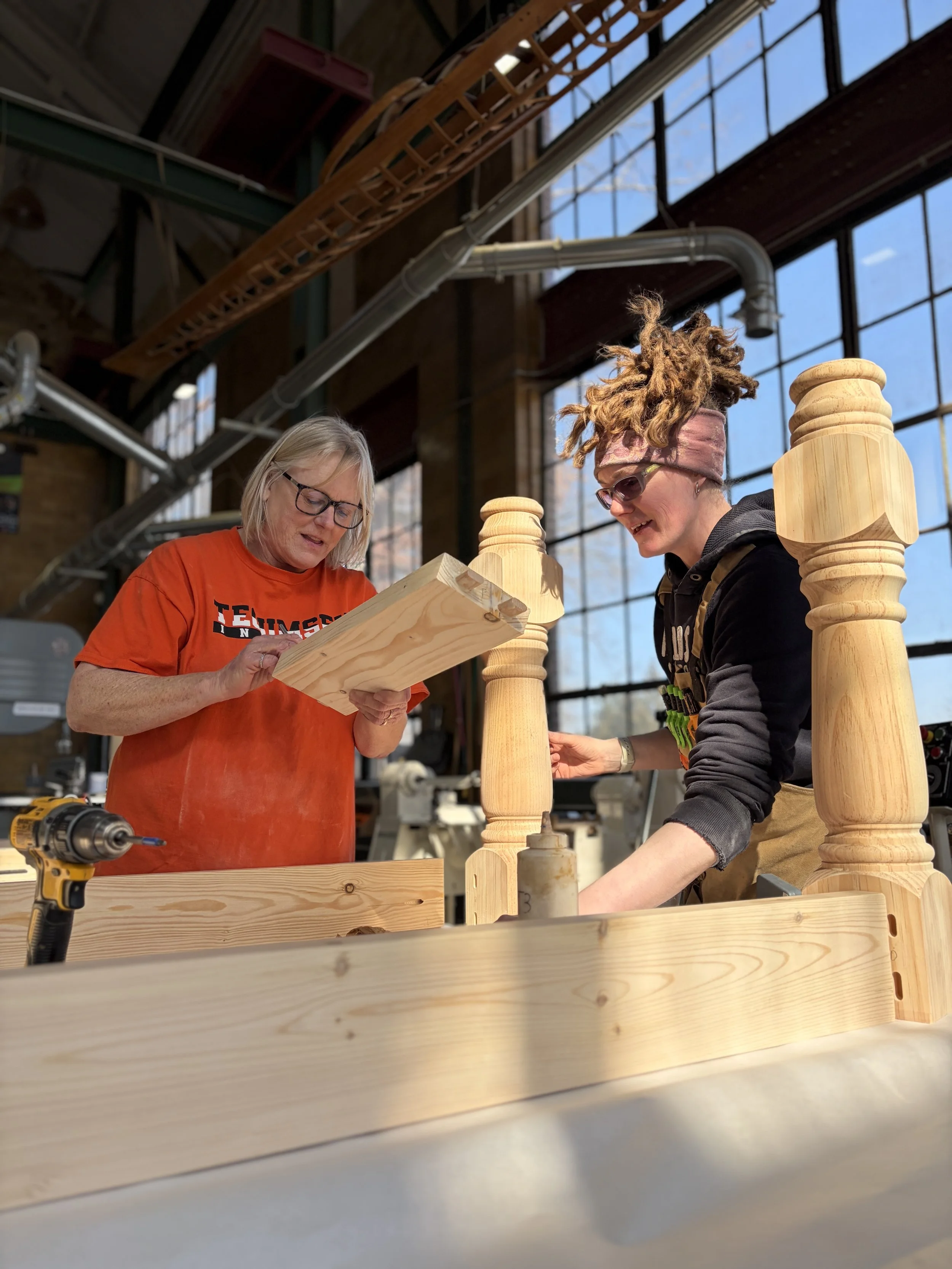
SBWI instructor and alumni Jamie Marvin (right) teaching a weekend farmhouse table class on campus.
What Is it really like for women in woodworking and the skilled trades?
For many women considering a career in skilled trades, the question isn’t “Can I do it?” but “Can I deal with it?”
We all know what it is: Being underrepresented in any field comes with challenges. You might not feel like you belong, imposter syndrome is real, and some may treat you like an outsider. We won’t sugar coat the realities of underrepresentation in the skilled trades, where women make up about 10% of the workforce. But we want to tell you this: at SBWI we believe women have an enormous opportunity to carve a new path as tradespeople and leaders. If you are here, you’re right on time. The next generation of woodworking is right now.
Stories From Our School
Alumni Carolyn Racine and Keighan McGoff offer a clearer picture of what it’s really like for women entering the trades today: challenging, empowering, creative, and increasingly welcoming.
One of the biggest barriers for women in the trades isn’t ability, it’s exposure.
“I wasn’t really socialized around tools,” says Carolyn Racine, Alumni ’24 and owner of Pigeon Princess Furniture. “A lot of women are not.”
When Carolyn enrolled, she had almost no prior experience. “I didn’t know how to use a drill. I’d used a chisel like, one time,” she recalls. “And I was just like, well, I’m going all in.”
That leap of faith paid off. What she found wasn’t gatekeeping, but structure and support. “As soon as you’re here, you’re treated like you’re someone going into a career field,” she explains. “It’s not just a hobby. It’s not just DIY.”
That distinction is critical. For women exploring woodworking as a serious career and not just a fun craft, being treated as a professional from day one builds confidence and credibility.
According to Carolyn, it’s about being given space to start at the beginning. “Here I’m given the space and the time to learn everything from zero,” she says. “And that has only made me feel more confident.”
Confidence doesn’t come from already knowing how to use the tools. It comes from being trusted to learn them. Carolyn also emphasizes that inclusion must be intentional. Seeing programs for veterans, and classes geared toward women and non-binary students, signaled something important to her about SBWI: “They’re trying to be a space for everybody. That doesn’t happen without trying. You have to put in the effort.”
Why Women Belong in Skilled Trades
For SBWI alumna Keighan McGoff, the conversation goes beyond representation, it’s about opportunity and long-term stability.
Woodworking, she says, offers something uniquely empowering: portable, adaptable skills. “It can ebb and flow, and a woman's life kind of demands that, which is a little bit different than men. There is a need to be able to change pace. And this is an industry where that is an option, which is cool.” Unlike some careers that demand a straight-line trajectory, skilled trades can flex with life’s seasons. Women may want a reliable, employable skill that allows them the flexibility to work and earn a living while caregiving and raising children. As women seek balance between career and family, a good wage and an in-demand skill is both an asset to them personally, and an asset to their family.
But the impact isn’t only personal, it’s creative.
“When you increase the voices in the room, you only get more exciting outcomes,” Keighan says, particularly in furniture design and artistic work. More perspectives push the craft further. Without diversity, she notes, a trade limits itself in ways it may not even recognize.
Carolyn agrees. “If you don’t have a diversity of people and backgrounds in an art form or a trade, that trade is not being pushed to its furthest limits. You’re not getting every perspective. You’re not getting every idea.”
What Is It Really Like for Women in the Trades?
At SBWI, we are intentionally making space through classes specifically for women. We employ women on our staff, and we accept women into our Wood Design program. This isn’t a traditionally female space, so, there may be some surprises along the way. But the most important thing is that everyone treats each other with respect and professionalism. Our instructors are dedicated to your success, and our leadership is devoted to sharing this incredible path with everyone who wants to learn it.
So, what is it really like for women in the trades?
It’s like walking into a space that hasn’t always reflected you, and discovering you belong there anyway.
It’s learning tools you weren’t raised around, and realizing competence is teachable.
It’s being treated as a professional, not a hobbyist.
It’s finding flexibility, financial stability, and creative fulfillment in work you build with your own hands.
And increasingly, it’s joining a growing network of women who are not only entering the trades, but expanding and redefining them.
The underrepresentation of women in woodworking is real. But so is the momentum. As more women step into shops, classrooms, and job sites, they are reshaping what the trades look like and what they can become.
Ready to Apply?
If you are ready, apply to our Wood Design program to prepare for a career in the trades. If you’re just looking to explore woodworking, taking a short course is a great way to get to know us.
If you have any questions, reach out to our Vice President of Enrollment who can walk you through all the above, and more.